Research Workspace Dashboard
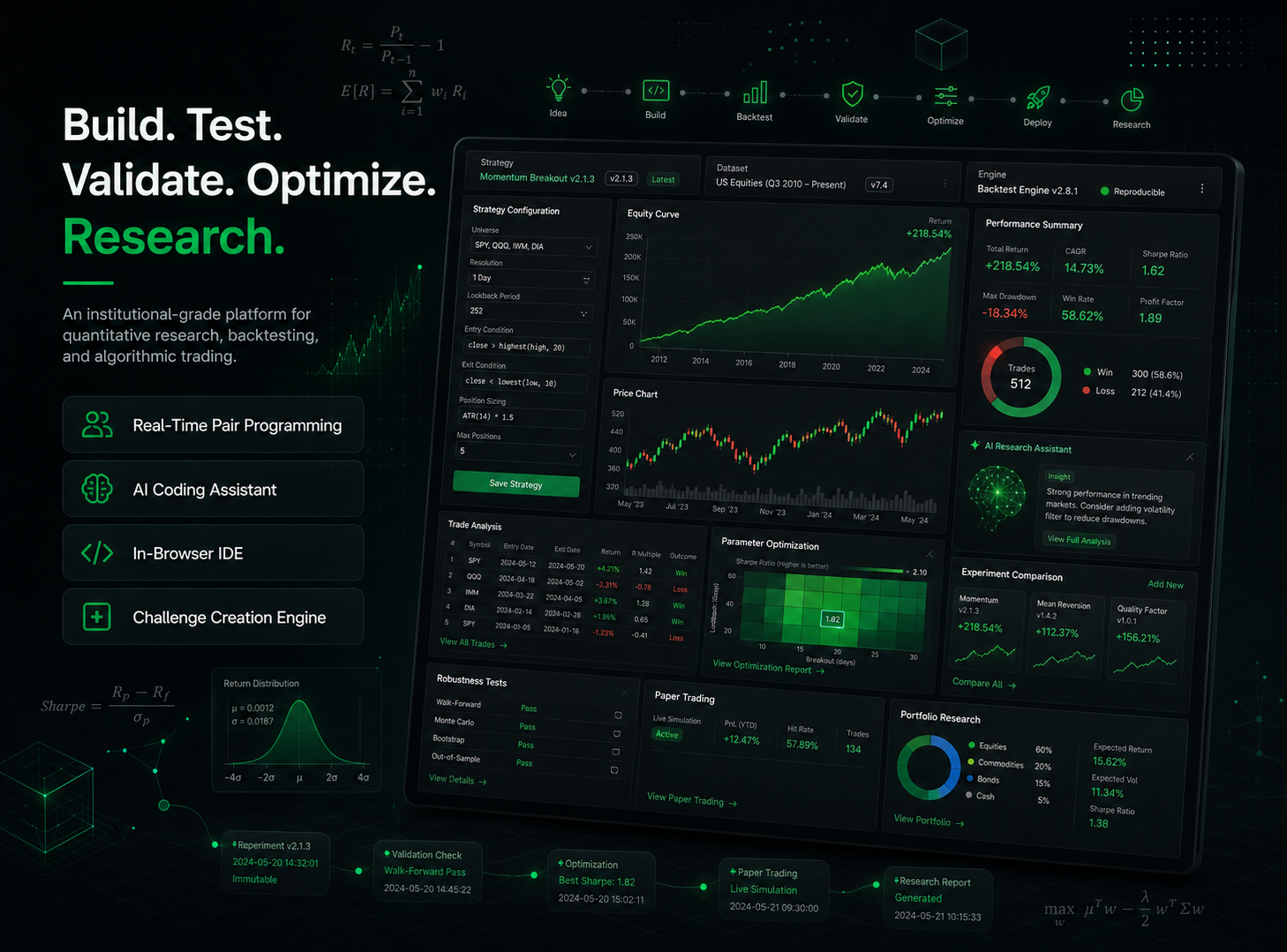
Central research home for recent strategies, active experiments, running jobs, validation states, alerts, and actionable workspace activity.
A complete quantitative strategy research ecosystem for designing, backtesting, analyzing, optimizing, validating, and paper-trading systematic investment strategies.
About the project
A full-stack quantitative research platform designed to take trading ideas from initial hypothesis through strategy construction, historical experimentation, trade-level analysis, optimization, robustness validation, and paper trading. QuantLab combines visual and AI-assisted strategy creation with reproducible backtesting, experiment management, market-data exploration, portfolio research, and collaborative workspace controls.
Platform
Digital Business Platform
Frontend
React / Vite
Focus
SaaS · Commerce · Content
Quantitative strategy research is often fragmented across notebooks, scripts, charting tools, data providers, optimization systems, and manual spreadsheets. This makes experiments difficult to reproduce, strategy versions hard to compare, backtest assumptions easy to overlook, and AI-generated insights difficult to trust. QuantLab needed a unified research environment where every strategy, dataset, experiment, trade, validation result, and optimization study remained traceable while still providing an approachable workflow for both visual and advanced quantitative researchers.
Designed a unified quantitative research ecosystem centered around a versioned Strategy IR and immutable experiments. Users can create strategies through AI, visual blocks, templates, or code, validate the resulting logic, configure reproducible backtests, monitor asynchronous research jobs, inspect quantitative performance and individual trades, compare strategy versions, run parameter optimization and out-of-sample validation, and forward-test validated strategies through paper trading. AI capabilities remain grounded in deterministic experiment data and platform tools instead of generating unsupported quantitative claims.
Creates a scalable foundation for systematic investment research by connecting strategy authoring, reproducible experimentation, quantitative analytics, AI-assisted reasoning, optimization, robustness testing, market-data exploration, paper trading, and portfolio-level analysis within one traceable research workflow.
Key Features
An end-to-end research environment covering strategy creation, quantitative experimentation, explainability, robustness analysis, and forward testing.
Central research home for recent strategies, active experiments, running jobs, validation states, alerts, and actionable workspace activity.
Transforms natural-language trading hypotheses into structured, editable strategy definitions with schema validation and explicit user approval.
No-code strategy construction using typed conditions, nested logic groups, dynamic calculations, actions, sizing policies, and reusable blocks.
Versioned research catalog for searching, organizing, duplicating, archiving, and continuing work across quantitative strategies.
Reusable quantitative strategy archetypes such as momentum, mean reversion, breakout, and trend-following models.
Pre-execution validation detects incomplete logic, unsupported features, contradictory rules, missing risk controls, and invalid configurations.
Reproducible experiment setup covering historical periods, dataset versions, initial capital, commissions, slippage, benchmarks, and execution assumptions.
Durable background research jobs with real execution stages, progress monitoring, cancellation, retry handling, and refresh-safe status tracking.
Comprehensive quantitative reports covering returns, drawdowns, Sharpe, Sortino, profit factor, trade statistics, rolling performance, and regime behavior.
Trade-level debugging and explainability with entries, exits, fills, fees, slippage, position changes, signal reasons, and historical chart context.
Side-by-side comparison of strategy versions and experiments across performance, assumptions, equity curves, drawdowns, regimes, and structural logic differences.
Evidence-grounded AI analysis explaining return drivers, drawdowns, regime dependence, trade clusters, potential weaknesses, and future research hypotheses.
Controlled parameter-search environment for studying candidate configurations, sensitivity, trade-offs, stable regions, and robustness rather than simply maximizing historical returns.
Out-of-sample, holdout, and walk-forward testing designed to detect overfitting and measure whether strategy performance survives unseen market data.
Research interface for inspecting instruments, OHLCV history, dataset coverage, features, indicators, corporate actions, adjustment policies, and data-quality issues.
Forward-testing environment for validated strategies using simulated capital, live or delayed feeds, risk controls, positions, orders, and execution monitoring.
Multi-strategy analysis covering allocations, combined returns, volatility, drawdowns, correlation, diversification, risk contribution, and stress scenarios.
Every historical experiment remains linked to its exact strategy version, configuration, dataset version, and engine assumptions for complete reproducibility.
All strategy-authoring methods compile into the same canonical Strategy IR, ensuring consistency across AI, visual, template, and code workflows.
Workspace administration with team members, permissions, data providers, API access, integrations, security configuration, and audit history.